
Industry Insights • 6 Min READ
Intelligence-Led Defence in the UK’s New Cyber Era
Jun 2026


Why Security Performance Matters More Than Ever in an Age of AI, Geopolitical Tension, and Supply Chain Risk
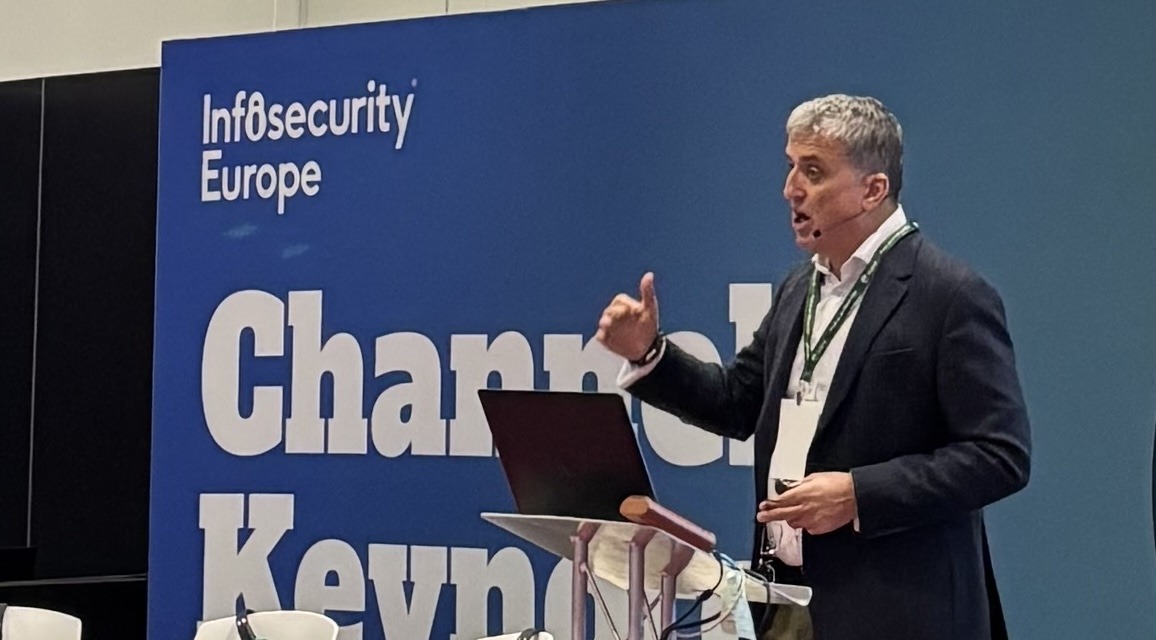
At Infosecurity Europe on Wednesday 2 June, SecurityHQ Founder and CEO Feras Tappuni explored a reality facing organisations across the UK and beyond: cybersecurity is no longer simply a technology challenge. It is a business resilience challenge shaped by geopolitical instability, AI-powered adversaries, and increasingly interconnected supply chains.
As cyber threats evolve faster than traditional security models can respond, organisations must rethink how they measure success. Security can no longer be judged by the number of tools deployed or alerts generated. Instead, the focus must shift towards measurable security performance — the ability to continuously improve detection, response, and resilience against emerging threats.
The Threat Landscape Has Entered a New Phase
The UK remains one of the most targeted nations in Europe, reflecting its position as a global financial centre, technology hub, and critical player in international defence and government operations.
Government agencies, defence contractors, manufacturers, financial institutions, and professional services organisations continue to attract significant attention from both criminal and state-sponsored threat actors. Attackers increasingly target organisations that provide strategic value, operational access, or opportunities for wider disruption.
At the same time, geopolitical developments are having a direct impact on cyber risk. Rising international tensions, military alliances, and global conflicts continue to influence cyber activity, with organisations often becoming indirect targets in broader geopolitical campaigns.
The result is a threat landscape that is more dynamic, interconnected, and unpredictable than ever before.
The Modern Adversary Operates Like a Business
Cybercrime has undergone a dramatic transformation over the past two decades.
What was once dominated by individual hackers and opportunistic malware has evolved into a sophisticated underground economy comprised of specialised actors, services, and supply chains.
Today’s ecosystem includes:
- Cybercrime enterprises operating at scale
- Transnational criminal syndicates
- State-sponsored advanced persistent threat (APT) groups
- Fraud and social engineering specialists
- AI-native threat actors leveraging automation and machine learning
These groups increasingly collaborate within mature criminal marketplaces that provide access, malware development, infrastructure, and monetisation services.
In many ways, modern cybercriminal organisations now operate with the same efficiency and specialisation as legitimate businesses.
Artificial Intelligence Has Changed the Rules
Perhaps the most significant shift shaping cybersecurity today is the rapid adoption of artificial intelligence by threat actors.
AI is accelerating every stage of the attack lifecycle.
Attackers are using generative AI to create highly convincing phishing campaigns, automate reconnaissance, identify vulnerabilities faster, and develop more sophisticated social engineering attacks. Deepfakes and synthetic identities are lowering barriers to fraud, impersonation, and insider compromise.
Recent campaigns demonstrate how quickly these capabilities are moving from theory to reality.
Threat groups such as Lazarus have reportedly leveraged real-time deepfake technology during remote job interviews to bypass identity verification and gain legitimate access to corporate environments. Other state-sponsored groups have used AI-generated content and AI-assisted personas to build trust with targets and conduct highly personalised phishing campaigns.
The implications extend far beyond cybersecurity teams.
AI-driven attacks create business risks that impact executive leadership, operational continuity, brand reputation, regulatory compliance, and customer trust.
Why Intelligence Matters More Than Tools
Many organisations continue to invest heavily in cybersecurity technologies, yet breaches still occur.
The issue is rarely a lack of tools.
Instead, security operations often struggle with:
- Excessive alert volumes
- Limited context around threats
- Generic detections that fail to reflect organisational risk
- Reactive response processes
- Difficulty measuring operational effectiveness
This is why intelligence-led defence is becoming increasingly important.
Rather than simply reacting to alerts, intelligence-led security focuses on understanding attacker behaviour, identifying emerging risks, and continuously adapting defences based on real-world threat activity.
Organisations need visibility not only into their own environments, but also into suppliers, partners, cloud platforms, digital assets, and external attack surfaces that adversaries increasingly target.
The goal is simple: anticipate attacks before they become incidents.
Supply Chain Risk Has Become a Board-Level Concern
Supply chain attacks continue to demonstrate how a single compromise can create widespread downstream impact.
Attackers increasingly exploit trusted relationships, software dependencies, cloud integrations, and third-party service providers as indirect paths into target organisations.
Recent incidents throughout 2025 highlighted how software ecosystems, CI/CD pipelines, open-source repositories, and SaaS platforms can become high-value attack vectors. In many cases, attackers achieved broad access by compromising trusted maintainers, supplier accounts, or software components rather than attacking victims directly.
The business consequences can be severe:
- Operational disruption
- Financial loss
- Reputational damage
- Regulatory scrutiny
- Extended recovery periods
As organisations become more interconnected, supply chain resilience must become a core component of cybersecurity strategy.
This requires continuous monitoring, threat intelligence integration, incident response planning, and improved visibility across third-party ecosystems.
Measuring Security by Performance
At SecurityHQ, we believe the future of cybersecurity lies in Security Performance Engineering.
This approach recognises that effective security is not defined by coverage alone. It is defined by outcomes.
Security operations should continuously improve over time through:
- Tailored security engineering designed for each organisation’s environment
- Ongoing optimisation and accountability
- Institutional intelligence gathered across global operations
- Measurable improvements in detection and response performance
The objective is not simply to operate security tools but to systematically improve the effectiveness of security operations.
Accelerating Outcomes with AI-Powered Investigation and Response
As threats increase in speed and complexity, security teams need technologies that help them make better decisions faster.
This is the philosophy behind SecurityHQ’s AXCEL platform.
AXCEL combines AI-powered triage, investigation, enrichment, and response into a closed-loop security operations model that continuously learns and improves.
By automatically refining signals, correlating intelligence, building incident context, and supporting response actions, AXCEL helps organisations:
- Detect threats earlier and more accurately
- Reduce alert fatigue
- Accelerate investigation workflows
- Improve response confidence
- Continuously optimise security operations
Most importantly, every incident contributes to future improvements, creating a system that becomes stronger with every investigation.
The Future Belongs to Adaptive Security Operations
The cybersecurity landscape is entering a new era defined by AI-enabled attacks, evolving geopolitical risks, identity-focused threats, and increasingly complex supply chain dependencies.
Organisations can no longer rely solely on reactive security models designed for a different generation of threats.
Success will depend on the ability to continuously measure, improve, and adapt security operations against an increasingly intelligent adversary.
The future of cybersecurity is not simply about having more tools.
It is about engineering better security performance.
And in a world where attackers are continuously evolving, organisations must do the same.