
Adversary Labs
Rapid Increase of Vulnerability Exploitation Through AI | SecurityHQ
Artificial intelligence is beginning to change the speed at which vulnerabilities can be researched, understood and potentially exploited.
There is now confirmed evidence of state-sponsored threat actors using large language models for reconnaissance, vulnerability research, scripting, malware development and post-compromise activity. However, it is important to separate confirmed activity from wider assumptions. There is currently no evidence that AI is responsible for every rapidly exploited vulnerability or that it is the sole reason exploitation timelines are decreasing.
What is clear is that attackers are already operating in an environment where the time available to defenders is becoming much shorter.
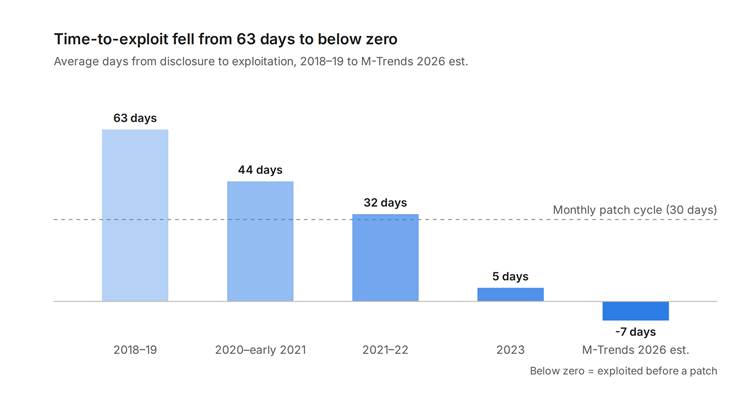
Mandiant’s analysis of vulnerabilities exploited in 2023 found that average time-to-exploit had fallen from 63 days in 2018-2019 to approximately five days in 2023. M-Trends 2026 reported an estimated mean time-to-exploit of -7 days, reflecting the number of vulnerabilities exploited before a patch was available. Exploitation also remained the most common initial infection vector observed by Mandiant for the sixth consecutive year. [1][2]
AI is now entering this already fast-moving environment and giving attackers and defenders new ways to automate work that previously required significant manual effort.
From Early AI to Generative AI
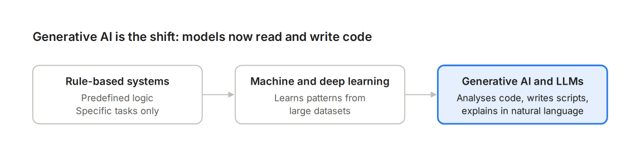
Artificial intelligence itself is not new. Early systems were largely rule-based and designed to perform specific tasks using predefined logic.
Over time, advances in machine learning and deep learning allowed systems to identify patterns from large datasets rather than relying entirely on manually written rules. The major shift came with modern generative AI and large language models. These systems can interpret natural language, analyse software code, generate scripts, explain technical concepts and assist with complex problem-solving.
This has obvious benefits for software development and cybersecurity. It also introduces risk.
A security researcher can use AI to understand unfamiliar code more quickly. An attacker can potentially use the same capability to analyse vulnerable functions, understand vendor patches, troubleshoot exploit code or automate reconnaissance.
How AI Is Being Used in Cybersecurity
AI is already being used by defenders across security operations.
Common use cases include malware analysis, alert triage, vulnerability assessment, log investigation, threat intelligence analysis and secure code review.
Microsoft provided a practical example in March 2025 when its Threat Intelligence team used Security Copilot alongside traditional techniques to analyse open-source bootloaders including GRUB2, U-Boot and Barebox.
The research identified several vulnerabilities, including an exploitable integer overflow. Microsoft estimated that the AI-assisted approach saved researchers approximately one week of manual review. [3]
This was defensive research, but it demonstrates the underlying capability.
If AI can reduce the time required for legitimate researchers to understand complex software, the same type of technology may also reduce the effort required by an attacker.
Confirmed Malicious Use of AI
There is now direct evidence that recognised threat actors are using generative AI during cyber operations.
Google Threat Intelligence Group has reported that state-sponsored actors associated with several countries have used generative AI for reconnaissance, scripting, vulnerability research, payload development and post-compromise activity. [4]
Microsoft has observed similar behaviour. In 2026, Microsoft Threat Intelligence reported that threat actors were using large language models to investigate publicly disclosed vulnerabilities and potential exploitation methods.
One example involved the North Korean threat actor tracked by Microsoft as Emerald Sleet, which used LLMs to research CVE-2022-30190, commonly known as Follina. [5]
Google has also identified AI being incorporated directly into malicious tooling.
The Russian state-sponsored actor APT28 used malware tracked as PROMPTSTEAL, which queried a large language model to generate Windows commands used to collect system information and documents from compromised environments.
Google described this as its first observed case of malware querying an LLM during live operations. [6]
This is an important development. AI is no longer only being used to write phishing emails or assist with basic scripting. In some cases, it is becoming part of the attack process itself.
How AI Can Accelerate Vulnerability Exploitation
Developing an exploit normally requires several stages.
An attacker must identify the affected product, understand the vulnerable component, analyse technical documentation or source code, determine whether exploitation is practical, develop or modify code and test the result.
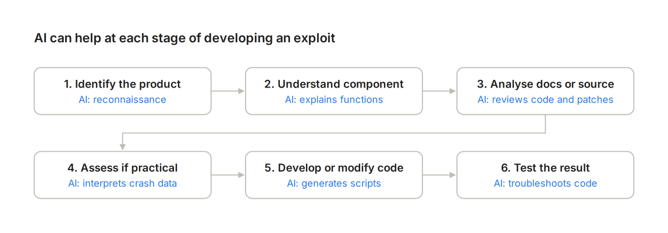
AI can assist with many of these tasks.
Modern models can explain vulnerable functions, review source code, interpret crash information, analyse software patches, generate scripts and troubleshoot code that does not initially work.
Google’s research into adversarial use of Gemini found threat actors using the system for vulnerability research, coding, reconnaissance and payload development.
Importantly, Google initially found that AI was mainly improving attacker productivity rather than creating entirely new offensive capabilities. [4]
That distinction matters.
AI does not need to independently discover a zero-day vulnerability to make an attacker more effective. Reducing the time needed to understand and operationalise an existing vulnerability can still have a significant impact.
The Exploitation Window Is Shrinking
The wider vulnerability landscape shows why this matters.
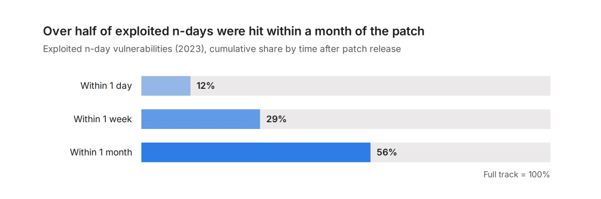
Mandiant analysed 138 vulnerabilities disclosed in 2023 that were known to have been exploited in the wild. Of the n-day vulnerabilities in its dataset, approximately 12% were exploited within one day of patch availability, 29% within one week and 56% within one month.
The longer-term trend is also significant.
Average time-to-exploit decreased from approximately 63 days in 2018-2019, to 44 days in 2020 to early 2021, 32 days during 2021-2022 and approximately five days in 2023. [1]
M-Trends 2026 later estimated a mean time-to-exploit of -7 days, reflecting the growing importance of zero-day exploitation. [2]
AI should not be presented as the sole cause of this decline. Automated scanning, increased zero-day research, exploit sharing, specialist threat groups and the targeting of internet-facing infrastructure are all contributing factors.
AI is another accelerator within that environment.
Security Research Shows What Is Possible
Some of the strongest evidence of AI’s vulnerability research capability currently comes from
defensive research.
Google Project Zero and DeepMind developed an AI-based vulnerability research agent known as Big Sleep.
In 2024, Big Sleep identified an exploitable memory-safety vulnerability in SQLite. The issue was reported to the developers and fixed before the vulnerable code reached an official release.
Google described the discovery as the first publicly reported example of an AI agent identifying a previously unknown exploitable memory-safety issue in widely used real-world software. [7]
Together with Microsoft’s bootloader research, this shows that AI can already perform useful vulnerability research outside controlled demonstrations.
What This Means for Organisations
The main issue for organisations is time.
Traditional vulnerability management programmes built around monthly patch cycles may struggle when high-value vulnerabilities move from disclosure to exploitation within hours or days.
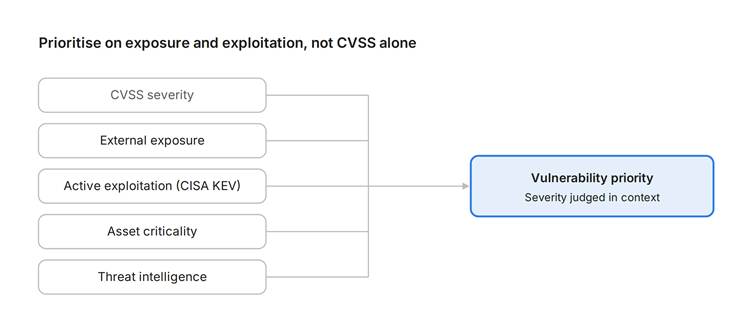
Security teams should not rely on CVSS scores alone. Vulnerability severity should be assessed alongside external exposure, active exploitation, asset criticality and available threat intelligence.
Internet-facing VPNs, firewalls, identity platforms, remote access systems and security appliances should receive particular attention.
Asset visibility is equally important. Organisations cannot respond quickly if they do not know where vulnerable technology is deployed.
CISA recommends using its Known Exploited Vulnerabilities catalogue as an input into vulnerability prioritisation because it identifies vulnerabilities with confirmed exploitation in the wild. [8]
Recommendations
Organisations should move towards continuous, intelligence-led vulnerability management.
Critical internet-facing systems should have emergency patching and mitigation processes that operate outside normal maintenance windows.
Where immediate patching is not possible, organisations should consider restricting external access, disabling vulnerable services, implementing vendor mitigations, increasing monitoring and conducting targeted threat hunting.
Security teams should regularly monitor CISA KEV, vendor advisories and trusted threat intelligence sources for evidence of active exploitation.
AI should also be considered defensively. Microsoft and Google have demonstrated that it can help security teams analyse complex code and identify vulnerabilities more quickly, but human validation should remain part of any security decision or remediation process.
Outlook for the Next 12 to 24 Months
- The strongest evidence today points towards AI being an accelerator rather than a fully autonomous attacker.
- Threat actors are already using AI for research, reconnaissance, scripting and malware operations. At the same time, defensive researchers have demonstrated that AI systems can discover real software vulnerabilities.
- As AI systems become better at analysing code, interacting with tools and working through technical problems, the gap between vulnerability disclosure and exploitation may come under further pressure.
- For organisations, the key challenge will be ensuring that defensive processes become faster at the same time.
Key Takeaways
- AI is already being used by real threat actors during cyber operations.
- There is confirmed evidence of AI being used for vulnerability research, reconnaissance, scripting and malware-related activity.
- Defensive research has also demonstrated that AI can identify previously unknown software vulnerabilities and significantly reduce manual research time.
- At the same time, there is no evidence that AI alone is responsible for the wider reduction in time-to-exploit.
- The most important issue is speed.
- As vulnerability analysis becomes increasingly automated, organisations will have less time to identify affected assets, understand exposure and implement remediation.
- Vulnerability management can no longer be treated purely as a scheduled patching exercise. It is becoming a continuous race between discovery, exploitation, detection and remediation.
Sources
[1] Mandiant, Time-to-Exploit Trends: 2023
https://cloud.google.com/blog/topics/threat-intelligence/time-to-exploit-trends-2023
[2] Google Cloud / Mandiant, M-Trends 2026
https://cloud.google.com/blog/topics/threat-intelligence/m-trends-2026
[3] Microsoft Threat Intelligence, Analyzing Open-Source Bootloaders: Finding Vulnerabilities Faster with AI
https://www.microsoft.com/en-us/security/blog/2025/03/31/analyzing-open-source-bootloaders-finding-vulnerabilities-faster-with-ai/
[4] Google Threat Intelligence Group, Adversarial Misuse of Generative AI
https://cloud.google.com/blog/topics/threat-intelligence/adversarial-misuse-generative-ai
[5] Microsoft Threat Intelligence, AI as Tradecraft: How Threat Actors Operationalize AI
https://www.microsoft.com/en-us/security/blog/2026/03/06/ai-as-tradecraft-how-threat-actors-operationalize-ai/
[6] Google Threat Intelligence Group, Threat Actor Usage of AI Tools
https://cloud.google.com/blog/topics/threat-intelligence/threat-actor-usage-of-ai-tools
[7] Google Project Zero, Big Sleep AI Vulnerability Research
https://googleprojectzero.blogspot.com/2024/11/
[8] CISA, Known Exploited Vulnerabilities Catalogue
https://www.cisa.gov/known-exploited-vulnerabilities-catalog

Let’s Talk
Global Security Operation Locations
Global Security Operation Locations
Analysts and engineers on staff
Years in business