
Cloud Security • 7 Min READ
Closing the Real Speed Gap in Cloud Security
Jul 2026


Why Faster Decisions, Not More Alerts, Will Define the Next Era of Cyber Defense
At SecurityHQ’s Cloud Security event in Chicago on 25 June, one theme stood above all others: the challenge facing security leaders is no longer a shortage of data.
It is a shortage of time.
Cloud environments generate unprecedented volumes of telemetry, intelligence, vulnerability data, and identity signals. Yet despite more visibility than ever before, many organizations still struggle to answer a fundamental question quickly enough:
Does this activity matter right now?
That gap between seeing a signal and making a confident security decision is becoming one of the defining risks of modern cybersecurity.
The Economics of Attack Speed Have Changed
For years, organizations believed that better visibility would lead to better security outcomes. The reality is proving more complicated.
Attackers have dramatically accelerated the pace of intrusion. Automated scanning now begins within minutes of newly disclosed vulnerabilities, and adversaries can target hundreds of organizations simultaneously. In many cases, the time between initial access and data exfiltration has shrunk from days to hours.
The issue is not simply that attacks are faster. It is that the economics of cybercrime have changed.
Automation and AI have made speed a competitive advantage for attackers. They can identify weaknesses, exploit exposures, and move laterally at the pace that traditional security operations struggle to match.
This creates a growing asymmetry between attackers and defenders.
Most security teams are still operating with processes designed for a world where analysts had time to investigate alerts, manually correlate data, and determine business impact. That world is disappearing.
Cloud Complexity Is Magnifying the Problem
Cloud has transformed how organizations build and scale technology, but it has also introduced a level of complexity that few operating models were designed to manage.
Critical security signals now exist across:
- Threat intelligence feeds
- Vulnerability management platforms
- Cloud telemetry
- Identity systems
- Business context and asset inventories
- Third-party environments
Each system tells only part of the story.
Individually, these signals may appear low risk. Together, they can reveal the early stages of a serious compromise.
This is often how breaches are missed.
A vulnerability may be actively exploited in the wild. An affected third-party asset may not be properly scoped. Unusual authentication activity may occur elsewhere in the environment. Viewed in isolation, none of these events appear urgent.
Viewed together, they may represent a developing incident.
The challenge is that most organizations cannot connect these relationships quickly enough.
Why Twenty Years of Security Innovation Has Not Solved the Problem
The industry has spent two decades pursuing better insight. SIEM platforms centralized data. SOAR platforms connected workflows. Threat intelligence added external context. Platform consolidation promised simplification.
Yet many organizations still struggle to make decisions at machine speed.
The reason is simple. Data is not the same as understanding.
Adding more tools does not automatically create context. In many environments, additional technologies increase complexity by creating more alerts, more dashboards, and more disconnected information.
Security operations do not fail because they lack telemetry. They fail because they cannot consistently transform telemetry into decisions.
The AI Inflection Point
Artificial intelligence is changing this equation. For the first time, context generation is becoming genuinely scalable.
AI can continuously correlate signals that historically existed in separate systems, identify relationships that humans would struggle to define in advance, and generate a richer understanding of what is happening across an environment. This does not remove the need for analysts or experienced security teams.
It changes where their time is spent.
Instead of manually gathering information, analysts can focus on interpretation, prioritization, and response. The organizations that benefit most from AI will not be those that automate the highest number of tasks. They will be the organizations that improve the quality and speed of decision-making.
Why CISOs Need a Different Operating Model
The shrinking response window has significant implications for leadership teams.
When intrusions can progress from exploitation to impact in a matter of hours, traditional security metrics become increasingly inadequate. Counting alerts, measuring tool coverage, or reporting ticket volumes says little about whether an organization is becoming more resilient.
The more important questions are:
- Are risks being identified earlier?
- Are decisions being made faster?
- Is context improving response quality?
- Is the security operation learning and adapting continuously?
These are performance questions rather than visibility questions. And increasingly, they are board-level concerns.
Business resilience now depends on the ability to make high-confidence security decisions at the speed of modern threats.
The SecurityHQ Perspective: Engineering Better Security Decisions
At SecurityHQ, this challenge is viewed through the lens of Security Performance Engineering.
The goal is not to generate more alerts or replace existing security investments. The goal is to continuously improve the measurable performance of security operations.
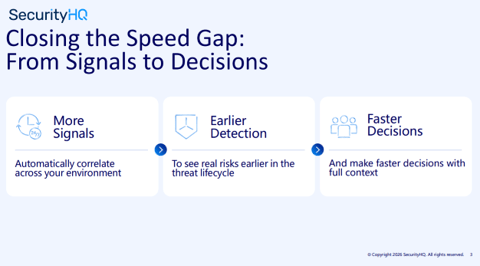
That means connecting intelligence, exposure data, identity signals, telemetry, and business context into a decision-making ecosystem that helps organizations detect risks earlier and respond with greater confidence.
In practice, this requires more than technology alone.
It requires an operating model that combines context generation, continuous optimization, and human expertise to ensure that security decisions improve over time.
The question facing organizations today is no longer whether they have enough information. The question is whether they can turn that information into action before an adversary does.
From Signals to Decisions
The next era of cloud security will not be defined by who collects the most data.
It will be defined by who can create understanding fastest.
As attackers continue to compress the threat lifecycle, the real competitive advantage for defenders will be their ability to correlate signals, generate context, and make decisions with greater speed and confidence.
The organizations that close this speed gap will not simply detect threats more effectively. They will build security operations capable of continuously adapting to whatever comes next.
Interested in learning more about Security Performance Engineering? We’d love to discuss how we can help. Fill in the contact form here and one of our experts will be in touch.