
Adversary Labs
The Binance Incident | SecurityHQ
The Binance Incident: Protecting the Transaction Path, Not Just the Key
SHQ Adversary Labs. A security architecture and SOC monitoring perspective for digital-asset and financial transaction platforms.
Executive overview
A protected signing key does not guarantee that every signing request is legitimate. That is the lesson of the reported October 29, 2026, Binance incident, in which about USD 6.3 billion left hot wallets without authorization.
On November 3, Binance published a fuller account, as reported by The Hacker News. It describes a “sophisticated, multi-stage campaign” rather than a single breach or a simple phishing incident: a trojanized Homebrew installer in June, fake job interviews aimed at a second engineer in September, abuse of an internal AI tool on October 20, and a container deployed on October 29 that reached an internal wallet signing service. Binance now puts the loss at about USD 6.43 billion, up from its first estimate of about USD 6.3 billion.
The lesson is that the attack went through people and developer tooling first, and only then reached the transaction path. Defenders need to protect both.
This post does not reconstruct Binance’s environment. It uses the incident to ask where preventive controls belong, which logs a security team need, and how SIEM monitoring can connect a privileged intrusion to an unauthorized financial transaction. It ends with questions every platform team should be able to answer, and a way to answer each one.
What we know, and what we don’t
| Claim | Status | Source |
|---|---|---|
| Hot wallets compromised around 20:05 UTC on Oct 29; loss now about $6.43B (first estimate $6.3B) | Binance statement | Binance, via The Hacker News |
| A “sophisticated, multi-stage campaign”, not a single breach or simple phishing incident | Binance statement | Binance, via The Hacker News |
| June 2026: a Wallet DevOps engineer downloaded a trojanized Homebrew installer found through a search engine. Binance detected it and rotated credentials, but information about his role and colleagues was exposed | Binance statement | Binance, via The Hacker News |
| September 2026: a second engineer was approached through a job platform for fake interviews and told to download an “assignment” containing a malicious code repository onto his work computer | Binance statement | Binance, via The Hacker News |
| Oct 20: the attacker used that laptop and abused an internal AI tool to gain control over two more engineers, and found a container deployment token on one of their computers | Binance statement | Binance, via The Hacker News |
| Oct 29, 17:15 to 19:56 (time zone not stated): using stolen credentials on a third engineer’s computer, the attacker deployed a container and ran a malicious script | Binance statement | Binance, via The Hacker News |
| The attacker used unauthorized access to an internal wallet signing service to start transactions outside the normal withdrawal process. An “advanced transaction-authorisation method” is mentioned but not explained | Binance statement | Binance, via The Hacker News |
| No evidence wallet private keys were leaked | Binance statement | Binance Recovery Update #2 |
| The delegation used in the Ethereum drain did not pass through Binance’s normal approval controls | Reported as a Binance statement by a secondary source; verify against Binance’s posts | SOCRadar |
| The attacker got Binance’s hot-wallet signing infrastructure to sign the transactions | Researcher assessment | TRM Labs, Elliptic |
| Staging on-chain began at least 36 hours earlier, with small Tornado Cash withdrawals funding an operator wallet on Oct 28 | Researcher finding | TRM Labs |
| Funds moved across about 10 blockchains | Researcher count (one source cites 11) | TRM Labs, Elliptic, Decrypt |
| Attribution to North Korea’s TraderTraitor | Analytics-firm attribution with “high confidence”; an FBI attribution on Oct 31 is reported by one secondary source. The Hacker News report of Binance’s account does not itself name the attackers. Chainalysis says similar fake-interview schemes have been linked to North Korea-linked actors | TRM Labs, Chainalysis, Decrypt, SOCRadar, The Hacker News |
| Which controls failed to stop the container deployment and the unauthorized signing requests, and how the “transaction-authorisation method” worked | Not disclosed | n/a |
How the money moved
The theft itself took about 20 minutes, but according to Binance’s account the intrusion behind it began months earlier, in June. The on-chain staging began at least a day and a half before the theft. Dates are UTC unless noted.
| Date and time | Event | Source |
|---|---|---|
| June 2026 | A Wallet DevOps engineer downloads a trojanized Homebrew installer. Binance detects it and rotates credentials, but information about his role and colleagues is exposed | Binance, via The Hacker News |
| September 2026 | A second engineer is lured through fake job interviews and told to download a malicious “assignment” onto his work computer | Binance, via The Hacker News |
| Oct 20 | The attacker abuses an internal AI tool to gain control over two more engineers and finds a container deployment token | Binance, via The Hacker News |
| Oct 28 | Operator wallet funded by three small Tornado Cash withdrawals | TRM Labs |
| Oct 29, 17:15 to 19:56 (time zone not stated) | Using stolen credentials on a third engineer’s computer, the attacker deploys a container and runs a malicious script | Binance, via The Hacker News |
| Oct 29, about 20:05 | Hot wallets compromised. A single Ethereum transaction carries 50 authorizations signed by a Binance hot wallet, pointing it at a sweeper contract. Outflows across about 10 chains follow within roughly 20 minutes | Binance, TRM Labs |
| Oct 29, about 23:05 to 23:56 | Second wave of outflows, reported on Avalanche and Polygon | TRM Labs, SOCRadar |
| Oct 30 | Binance names a possible DevOps laptop entry point, reports about $3B frozen on-chain, then says additional breach points exist | Binance |
| Oct 31 | FBI attribution to TraderTraitor reported by one secondary source | SOCRadar |
| Nov 1 | Phased withdrawals resume, starting with Bitcoin across 15 networks; the first nine and a half hours show about $3.64B net outflow | Binance, CoinDesk |
| Nov 1 to 2 | About 95% of affected assets replenished from company funds (sources differ on the exact date); zero-knowledge proof of reserves completed. Replenishment is not recovery from the attacker | Binance |
| Nov 3 | Binance publishes its fuller account of the attack chain. Recovery Update #6: withdrawals restored for dozens more Ethereum and Solana assets; other networks to follow after security checks | Binance, The Hacker News, trade press |
About $3B is frozen on-chain, mostly by stablecoin issuers. TRM estimates about $2.4B remains with the attacker beyond any issuer’s reach.
How a digital-asset platform is structured
This is an illustrative architecture for an exchange, custodian, stablecoin issuer or financial transaction platform. It is not a depiction of Binance, and real deployments separate custody, treasury, approval and signing differently.
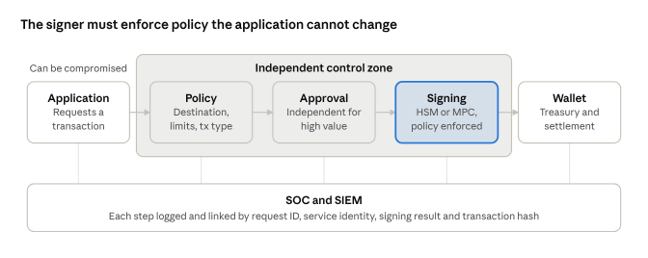
Transaction path · 5 steps, 1 independent control zone
The key boundary sits between the application that requests a transaction and the independently operated controls that authorize it. The signing service should validate intent against policy, approval and risk decisions that the application cannot change. A SOC must be able to link every step by request ID, service identity, signing decision and on-chain transaction hash.
Which controls can prevent or limit an incident?
The central risk is simple: if a compromised but trusted application can request a signature without a separately enforced transaction policy, an attacker can misuse the authorized signing path while the key stays protected.
- API and orchestration layers: require strong caller identity, authenticated requests, transaction integrity checks and behavioral rate limits.
- Policy layer: enforce destination allowlists, asset and contract restrictions, per-transfer and rolling-value limits, and independently approved high-value transactions.
- Signing layer: use HSM or MPC key protection with signing-policy enforcement independent of the potentially compromised workload. Log both approved and rejected decisions.
- Treasury and wallet layers: minimize hot-wallet balances, segregate signing domains, limit automated refills, and suspend replenishment when withdrawal patterns turn anomalous.
- Administrative systems: isolate privileged endpoints, enforce phishing-resistant MFA and just-in-time access, and keep an emergency suspension mechanism outside the compromised application.
Why the signing policy must read the transaction type
Per TRM and SOCRadar, the Ethereum drain used EIP-7702 delegation. One transaction carried 50 pre-signed authorizations from a hot wallet, each pointing at an attacker-controlled sweeper contract. A destination allowlist or value limit does not see this, because the signed object is not a transfer. It is permission for another contract’s code to act as the wallet.
A signing policy therefore needs to inspect transaction type and payload, not only destination and amount. Hot-wallet signers should reject delegation and authorization-list payloads unless a separate, approved process requested them.
What should the SOC monitor?
No single alert tells this story. The value is in chaining identity, workload, signing and on-chain signals within minutes of each other. These are detection opportunities, not confirmed indicators from Binance’s investigation.
| Stage | Detection | Telemetry | Priority |
|---|---|---|---|
| Lure and install | Privileged work device installs developer tools from non-official sources, or runs code from a recruiter-supplied repository | EDR, DNS and proxy logs | High |
| Endpoint | Privileged workstation with new tooling, unusual child processes or credential access | EDR | High |
| Credentials | Deployment or cloud tokens found on, or used from, a developer laptop or a new device | EDR, IAM and PAM logs | High |
| Internal tooling | An internal AI tool or automation acting for one engineer inside another engineer’s session, or touching deployment credentials | AI-tool and identity audit logs | High |
| Access | Production access from an unfamiliar device or IP, or outside change windows | Identity and PAM logs | High |
| Workload | Exec, create or patch actions in wallet and signing namespaces, or container deployments outside the approved pipeline | Kubernetes and cloud audit logs | High |
| Privilege | Service-account permission or role changes | IAM and cloud audit logs | High |
| Staging | Fresh operator wallet funded via mixers, then interacting with your contracts or counterparties | Blockchain intelligence feeds | Medium |
| Signing | Requests outside approved policy or outside the normal withdrawal workflow; unusual batch or authorization-list payloads from a hot wallet | Signing service audit logs | Critical |
| Destination | High-value transfers to never-seen addresses or freshly deployed contracts | Wallet and transaction logs | Critical |
| Velocity | Simultaneous outflows across many chains, or sweeps of many assets in minutes | Cross-chain transaction monitoring | Critical |
The first rows are commonly covered by standard SOC integrations. The signing, destination and velocity rows need custom application telemetry or dedicated transaction-monitoring connectors. Without them, a SIEM cannot tell whether an authorized-looking signing request was financially legitimate.
We would expect the last three rows to give real-time visibility in an incident like this. A rule that pauses signing when outflow velocity crosses a threshold is worth more than any single endpoint alert.
Questions for your teams this week, and how to answer them
Each question below comes with the evidence to gather, the team that owns it, and what a good answer looks like. Questions 8 to 10 come from Binance’s account of how the attacker got in. If you cannot answer questions 1, 2, 5 and 8 with evidence, treat them as your priority gaps.
| Question | How to answer it | Owner | A good answer looks like |
|---|---|---|---|
| 1. If our withdrawal service were fully compromised, what independent control would still stop an unauthorized transaction? | Map the path request, policy, approval, signing. Mark each control as inside or outside the application’s trust zone. Then test it: in a test environment, submit an out-of-policy request using the service’s own credentials | Platform architecture, custody | The signer rejects the request using rules the application cannot edit |
| 2. Can a hot-wallet key sign anything other than a plain transfer, such as a delegation or contract authorization? | List the transaction and payload types each signer accepts. In staging, submit a delegation or authorization-list payload and record the result | Custody and signing team | Unsupported types are rejected and logged |
| 3. Does our SOC receive signing and transaction telemetry, or only infrastructure logs? | Compare the visibility checklist in Section 8 with your real log sources. Mark each row received, partial or missing | SOC lead | Request ID, signer decision and transaction hash all reach the SIEM |
| 4. Can we correlate a privileged login, a production workload change and a spike in signing requests within ten minutes? | Run Hunt 5 in Section 7 against a replayed test scenario and time how long the chain takes to alert | Detection engineering | An alert fires in under ten minutes with all three signals attached |
| 5. Who can suspend signing at 3 a.m., and does that power survive a compromise of the application host? | Read the runbook, name the people, and confirm where the pause control lives. Run a timed drill | Incident response, treasury | A named on-call person can pause signing within minutes, from outside the compromised host |
| 6. How much could leave in 20 minutes, and which control would trip first? | Add up hot-wallet balances and the fastest outflow your limits allow. Compare that with your per-transfer and rolling caps | Treasury, risk | Rolling limits cap the loss at a figure the business has accepted in writing |
| 7. When did we last rehearse this with finance, treasury and our asset issuers? | Look for a tabletop exercise in the last six months. Check that you hold 24/7 contacts at the stablecoin issuers that can freeze funds | Incident response | A dated exercise with actions closed, and issuer contacts on file |
| 8. Could a token on an engineer’s laptop deploy into our wallet or signing environment? | List deployment and cloud credentials in your secrets stores and scan privileged laptops for credential files and CLI configuration. Check each token’s lifetime, scope and approver. Try a deployment from a test laptop | Platform security, DevOps | No long-lived tokens on laptops; deployments use short-lived, scoped credentials plus a second approval |
| 9. What can our internal AI tools and automation reach, and whose permissions do they use? | Inventory the tools. List each connector and permission. Test whether one engineer’s session can act in another’s. Check that tool actions appear in the SIEM | IT security, tool owners | Least privilege per user, actions logged, and no way to take control of another engineer’s session |
| 10. Could an engineer run a recruiter’s “coding test”, or a tool found through a search ad, on a work laptop? | Review the policy and the software install controls. With approval, run a harmless fake assignment and a fake installer test and see whether the endpoint tool blocks or alerts. Check that engineers have a disposable virtual machine for unknown code | Endpoint security, security awareness | Blocked or alerted within minutes, with a safe place to open unknown code |
KQL: practical starting hunts for Microsoft Sentinel
These are hunting templates, not indicators from the incident, and they are not ready for automatic blocking. Validate table names, field names, namespaces, schemas and time windows against the data you actually collect. KQL column names are case-sensitive. The two custom tables, SigningAudit_CL and WalletTransactions_CL, are illustrative ingestion schemas, not built-in Sentinel tables.
Hunt 1: Privileged endpoint using production administration tools
DeviceProcessEvents
| where Timestamp > ago(24h)
| where FileName in~ ("kubectl.exe", "kubectl", "docker.exe", "docker", "az.exe", "az", "aws.exe", "aws")
| where ProcessCommandLine has_any ("exec", "signing-prod", "wallet-prod", "secrets", "assume-role")
| project Timestamp, DeviceName, AccountName, FileName, ProcessCommandLine, InitiatingProcessFileName, InitiatingProcessCommandLine
| order by Timestamp desc
Requires Microsoft Defender XDR DeviceProcessEvents. Scope it to privileged endpoints. Deployment automation will produce expected matches, and “exec” is broad, so tune it.
Hunt 2: New source IP modifying sensitive Kubernetes workloads
let Critical = dynamic(["wallet-prod", "signing-prod"]);
let Known = AKSAudit
| where TimeGenerated between (ago(30d) .. ago(1d))
| where tostring(ObjectRef.namespace) in (Critical)
| extend Actor = tostring(User["username"])
| mv-expand SourceIP = SourceIps
| extend SourceIP = tostring(SourceIP)
| distinct Actor, SourceIP;
AKSAudit
| where TimeGenerated > ago(1d)
| where tostring(ObjectRef.namespace) in (Critical)
| where Verb in~ ("create", "update", "patch", "delete")
| extend Actor = tostring(User["username"])
| mv-expand SourceIP = SourceIps
| extend SourceIP = tostring(SourceIP)
| join kind=leftanti Known on Actor, SourceIP
| project TimeGenerated, Actor, SourceIP, Verb, ObjectRef, RequestUri
Requires AKSAudit where ingested. Confirm that the namespace sits inside the ObjectRef column in your schema. Pod exec may be logged as a create on the exec subresource. Tune for pipelines and jump hosts.
Hunt 3: Unusual signer activity, authorization payloads and rejected decisions
// Illustrative CUSTOM table: SigningAudit_CL
SigningAudit_CL
| where TimeGenerated > ago(1h)
| where Action == "sign_request"
| summarize Requests = count(),
    Denied = countif(PolicyDecision != "allow"),
    AuthListRequests = countif(HasAuthorizationList == true),
    DistinctDestinations = dcount(DestinationAddress)
    by bin(TimeGenerated, 5m), WalletAddress, ServiceIdentity
| where Requests > 30 or Denied > 3 or AuthListRequests > 0 or DistinctDestinations > 10
| order by Requests desc
Custom fields required: Action, PolicyDecision, HasAuthorizationList, DestinationAddress, WalletAddress and ServiceIdentity. Thresholds are placeholders. Use observed baselines and business policy limits. AuthListRequests > 0 is deliberately strict: a hot wallet should rarely, if ever, sign an authorization list.
Hunt 4: Rapid withdrawal activity to new recipients
// Illustrative CUSTOM table: WalletTransactions_CL
let KnownDestinations = WalletTransactions_CL
| where TimeGenerated between (ago(30d) .. ago(1d))
| distinct WalletAddress, DestinationAddress;
WalletTransactions_CL
| where TimeGenerated > ago(1d)
| join kind=leftanti KnownDestinations on WalletAddress, DestinationAddress
| summarize TxCount = count(), TotalAmount = sum(Amount),
    NewDestinations = dcount(DestinationAddress), Chains = make_set(Chain, 20)
    by WalletAddress, bin(TimeGenerated, 10m)
| where TxCount >= 5 or NewDestinations >= 3
| order by TxCount desc
Custom fields required: WalletAddress, DestinationAddress, Amount and Chain. Normalize Amount to a comparable denomination or segment by asset. Tune the count thresholds.
Hunt 5: Privileged access, workload change and signing spike in one window
let Window = 10m;
let Access = SigninLogs
| where TimeGenerated > ago(1d)
| project TimeGenerated, Signal = "privileged_signin";
let Workload = AKSAudit
| where TimeGenerated > ago(1d)
| where Verb in~ ("create", "update", "patch", "delete")
| where tostring(ObjectRef.namespace) in ("wallet-prod", "signing-prod")
| project TimeGenerated, Signal = "workload_change";
let Signing = SigningAudit_CL
| where TimeGenerated > ago(1d)
| summarize Requests = count() by bin(TimeGenerated, 5m)
| where Requests > 30
| project TimeGenerated, Signal = "signing_spike";
union Access, Workload, Signing
| summarize Signals = make_set(Signal), SignalCount = dcount(Signal) by bin(TimeGenerated, Window)
| where SignalCount == 3
This answers question 4. Filter SigninLogs to your privileged accounts and administrative applications first, or it will match everything. Fixed time bins can split a real chain across two windows, so run it with an offset bin as well, and add a shared entity such as a service account or source IP where your logs allow it.
Hunt 6: Privileged workstation installing tools or running repository code that contacts a new domain
let PrivilegedDevices = dynamic(["dev-laptop-01", "dev-laptop-02"]); // replace with your watchlist
let KnownDomains = DeviceNetworkEvents
| where Timestamp between (ago(30d) .. ago(7d))
| where DeviceName in~ (PrivilegedDevices)
| distinct RemoteUrl;
let Installs = DeviceProcessEvents
| where Timestamp > ago(7d)
| where DeviceName in~ (PrivilegedDevices)
| where ProcessCommandLine has_any ("install.sh", "git clone", "npm install", "pip install", "setup.py", "postinstall", "brew install")
| project DeviceId, DeviceName, AccountName, InstallTime = Timestamp, ProcessCommandLine;
Installs
| join kind=inner (
    DeviceNetworkEvents
    | where Timestamp > ago(7d)
    | where isnotempty(RemoteUrl)
    | project DeviceId, NetTime = Timestamp, RemoteUrl, InitiatingProcessFileName
) on DeviceId
| where NetTime between (InstallTime .. InstallTime + 10m)
| join kind=leftanti KnownDomains on RemoteUrl
| project InstallTime, DeviceName, AccountName, ProcessCommandLine, RemoteUrl, InitiatingProcessFileName
| order by InstallTime desc
This targets the lure-and-install stage Binance described, but it is a template and not an indicator from the incident. Requires Microsoft Defender XDR DeviceProcessEvents and DeviceNetworkEvents. Build the device watchlist from your real DevOps and wallet-infrastructure engineers. Expect noise from legitimate installs, so tune it against your own baseline.
Visibility checklist and response ownership
Every critical event should be timestamped, attributable, and linked through transaction request ID, service identity, signing result and blockchain transaction hash. No single log type proves a complete chain.
| Required integration | What it enables | Primary owner |
|---|---|---|
| EDR, IAM and PAM, cloud audit | Compromise and unauthorized-access investigation | SOC and IT security engineering |
| Developer endpoint, software-install and package-source telemetry | Detect trojanized installers and unknown code running on privileged laptops | Endpoint and platform security |
| Internal AI-tool and automation audit logs | Detect one engineer’s session being used to act for another | IT security, tool owners |
| Payment and policy decision logs | Business authorization and payment-risk monitoring | Application and risk engineering |
| Signing service, HSM and MPC logs, including transaction type and origin | Link each request to its approval and signing outcome | Custody and signing platform team |
| Wallet ledger and blockchain feed | Withdrawal anomaly and cross-chain investigation | Wallet operations and transaction monitoring |
| Emergency pause and revocation controls | Immediate containment when risk is credible | Platform, treasury and incident response |
For automatic containment, transaction systems should enforce independent rules. A SIEM alert can then escalate or invoke a preauthorized response workflow, rather than being the only safety mechanism
Key takeaway
Securing a high-value financial platform means protecting more than credentials and private keys. Organizations must secure the whole transaction path: request, policy, approval, signing, treasury release and settlement.
SOC monitoring gets meaningfully stronger when infrastructure telemetry is correlated with financial transaction intent and outcome. Binance’s own account adds a second lesson: the route to the signing service ran through engineers, their laptops and an internal AI tool, so those need the same protection as the keys. The goal is not only to detect an attacker, but to stop a trusted system from completing an unauthorized high-impact transaction.
References and Research Boundaries
Binance statements are distinguished from researcher and third-party interpretation throughout. I did not open Binance’s own pages. Binance’s November 3 account is cited through The Hacker News, so check Binance-attributed statements against the originals before publishing.
- Binance, Security Incident Update, October 30, 2026
- Binance, Security Incident Update #2, October 30, 2026
- The Hacker News, Binance reveals how fake job interviews led to the theft, November 3, 2026
- Source research: Binance’s $6.3B Hack: When the Signer, Not the Key, Is the Target (November 3, 2026)
- Decrypt, TRM and Chainalysis tie $6.4B Binance hack to North Korea’s TraderTraitor
- SOCRadar, Binance hack: $6.3B hot wallet theft
- TRM Labs and Elliptic research reports, CoinDesk reporting on the Nov 1 withdrawal restart, and the FBI statement of Oct 31 are cited above but not yet linked. Add the primary links before publishing.

Let’s Talk
Global Security Operation Locations
Global Security Operation Locations
Analysts and engineers on staff
Years in business