

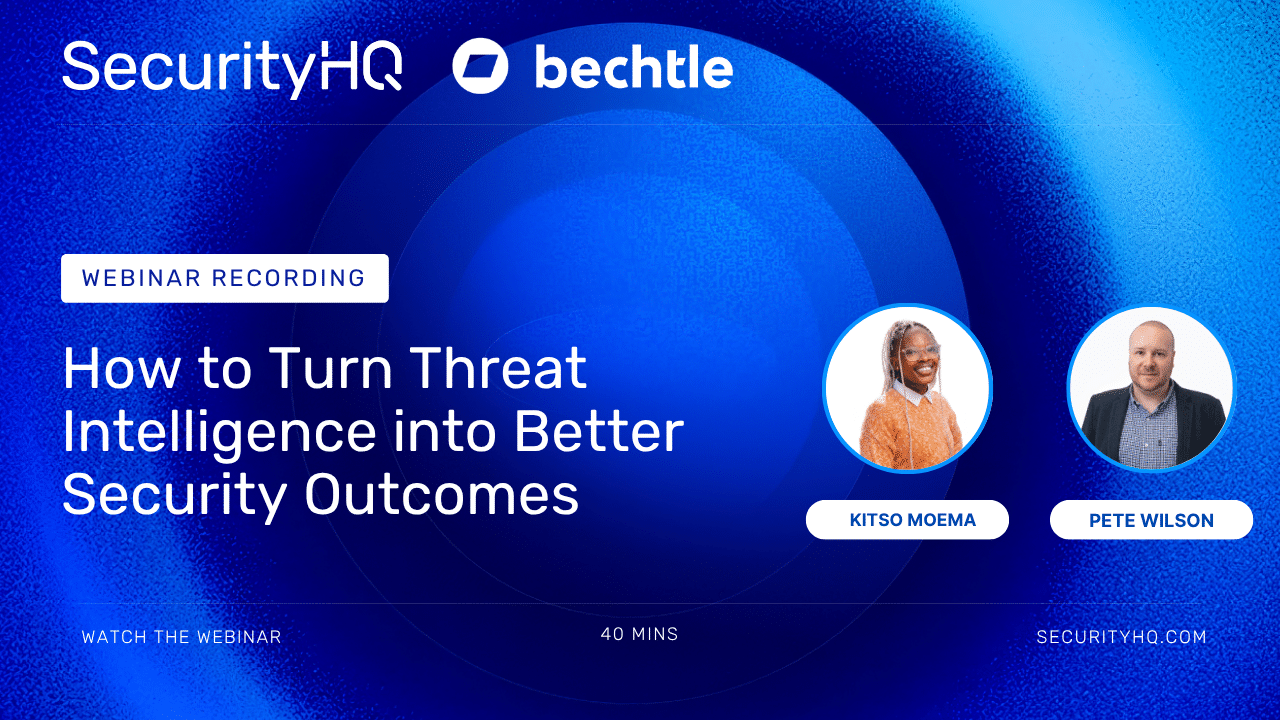
Threat intelligence only earns its place when it changes what your team does next. That was the thread running through our recent webinar with our partner Bechtle, How to turn threat intelligence into better security decisions, held on Wednesday 30 September.
Most security teams are not short of data. They are buried in feeds, alerts and reports, and the hard part is knowing what matters, what to fix first and when to act. Miss the wrong signal, and an attacker may get the opening they need to disrupt operations or compromise sensitive data.
Kitso Moema, Threat Intelligence Specialist and Pete Wilson, Security Consultant at Bechtle used real-world scenarios to show how intelligence can drive clearer decisions. Here is a recap of what they covered, and how you can put it to work.
Different intelligence for different decisions
Threat intelligence is not a single feed. It is information about threats, attackers and their methods, analysed so that people can act on it. Different types of intelligence serve different people and decisions:
- Strategic intelligence helps leaders understand the threat landscape and shape investment and risk decisions.
- Operational intelligence describes specific campaigns and threat actors, so teams can anticipate how an attack might unfold.
- Tactical intelligence covers attacker tactics, techniques and procedures, which informs detection rules and defensive controls.
- Technical intelligence includes indicators such as malicious IPs, domains and file hashes, used for blocking and alerting.
The starting point is matching the right intelligence to the right decision. A board does not need a list of hashes, and a SOC analyst needs more than a quarterly trend report.
Why threat data so often goes unused
Many organisations collect plenty of threat data but struggle to act on it. Common reasons include too many sources with overlapping or low-quality content, and intelligence that arrives without context about the business. Teams are also often too stretched to analyse it properly.
The result is a familiar pattern. Analysts spend their time sorting through noise, important signals get lost, and intelligence becomes a report that is read rather than a tool that shapes decisions. Closing that gap is less about adding more feeds and more about filtering, context and clear ownership.
Where AI helps analysts
AI is changing how analysts handle the volume of intelligence they receive. It can summarise lengthy reports, group related indicators, and flag which items are most likely to be relevant to a given organisation. That frees analysts to spend more time on judgement and less on triage.
AI works best as support for analysts, not a replacement for them. Human expertise is still needed to validate findings, understand business context and decide what action to take.
Prioritising vulnerabilities with context
No team can patch everything at once, and severity scores alone do not show which vulnerabilities pose the greatest risk. Threat intelligence adds the missing piece: whether a vulnerability is being actively exploited, and by whom.
Combine that threat context with business context, such as which systems hold sensitive data or support critical services, and prioritisation becomes much sharper. A medium-severity flaw on an internet-facing system that attackers are actively targeting may need fixing before a critical flaw on an isolated test server.
Intelligence in day-to-day security operations
Good intelligence feeds directly into the work of a security operations centre (SOC):
- Threat hunting. Knowing which actors target your sector, and how they operate, gives hunters specific hypotheses to test instead of searching blindly.
- Incident response. When an alert fires, intelligence helps responders quickly judge who might be behind it, what they are likely to do next and how serious it is.
- Daily SOC operations. Intelligence enriches alerts, improves detection rules and helps analysts separate genuine threats from false positives.
When intelligence is built into these workflows, teams respond faster and with more confidence.
Five questions to test your threat intelligence
The webinar closed with practical questions to help organisations judge whether their intelligence is delivering value. Ask yourself:
- Is our intelligence relevant to our sector, geography and technology stack?
- Does it reach the people who make decisions, in a form they can use?
- Can we point to recent decisions or actions it has changed?
- Does it help us prioritise vulnerabilities and alerts, or just add to the volume?
- Do we have the people and processes to analyse it and act in time?
If the answer to any of these is no, your intelligence may be generating activity without improving outcomes.
How SecurityHQ and Bechtle work together
Our partnership with Bechtle brings together Bechtle’s technology expertise with SecurityHQ’s threat intelligence and managed security operations. Together, we help organisations cut through the noise and focus on the risks that matter most.
The aim is simple: turn more data into better decisions, faster action and stronger security outcomes.
Watch the recording
Missed the live session, or want to share it with your team? Watch the full webinar to see Kitso and Pete walk through the real-world scenarios in detail.
To discuss how threat intelligence could support your security decisions, get in touch with our team.
Watch the full webinar
Enter your details to unlock the recording.